Wednesday, February 27, 2013

CHANGING FACE OF HR FOR BUSINESS SUCCESS

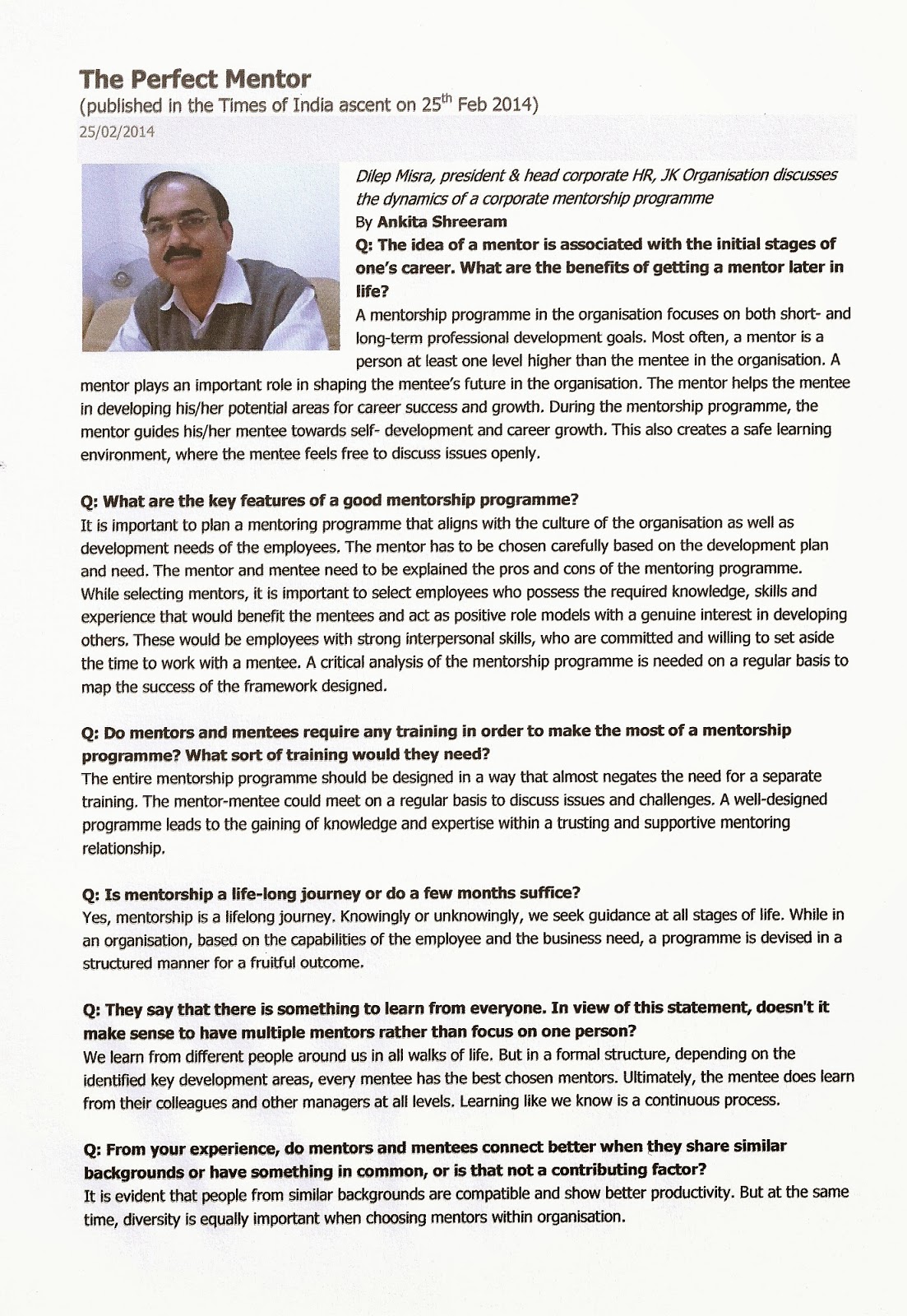
Dilep Misra


In today’s world the economy is slowly getting tilt from north to south. This means the business is happening more now in the countries like China, India, Philippines, Vietnam etc. With the Competition catching up at business place there is also an increase in uncertainty in the business. 

In the competitive market environment to make the business successful People Strategy and practices needs to be reviewed and aligned with the business Goal.

We all know that the success of the Organization comes with the satisfaction of its stakeholders.

The main stake holders of an organization are Investors, Customers, Vendors, Employee, Government and Society.

Broadly the Organization focuses on the following needs of its stakeholders\

• Increase in market share
• Increase in PAT
• Producing quality product at a competitive price
• Best customer service
• Improve in Quality of work life
• Meeting all standards of Corporate Governance & Compliances
• Improved responsiveness & concern for the society
We need motivated passionate people at the organization to meet the above needs of the organization. We want people to bring their HAND…HEAD…and HEART to the work place. People should feel enthusiastic and happy to work at the Organization.

This can happen only if we improve the quality of work life and take care of their major concerns at work place.

Every Business is for making profit. If you want to improve the PAT of your business, continue to identify the performers and pat on their back.

The three major roles HR plays in any organization are transactional, transformational, and transitional. The challenges faced by human resource managers in India are naturally evolving with the ever-transforming scenario in corporate India. Following are some of the major areas where HR need to focus more in the coming future.
  • Managing globalization: With more and more Indian Business houses are getting global by acquisition of Industries outside the country, It is important for  HR Manager to relook at their people management practices. The culture of the local place has to be kept in mind before devising/Implementing any new practice for the employee there. The HR need to think of policies more suitable for the people at respective locations.
  • Business Alignment: Today it is important for every HR professional to understand the business. This helps HR professionals in developing a right strategy for the business. The people strategy and policy of the organization has to be aligned with the business goal and Employee oriented. HR needs to be concerned about their employee and at the same time business driven. If the HR initiatives and strategy are closely aligned with business Goal, the success of it will impact the business outcome. 
  • Developing leadership skills: It is about developing people against the right Leadership competencies, to shoulder leadership role and steer the organization to achieve its strategic goal. Since the global economic and industrial scenario is very uncertain and challenging, what is required now is to develop a right skill to face the challenges and bring success to the organization.
  • Innovation at work place: In today’s competitive world with growing uncertainty, to stay competitive the business needs to come out with innovative ideas in the business i.e new process, New Products etc. The HR can work on setting up an environment in the organization and help people to become more innovative in their approach.  It is a huge challenge before the HR to neutralise the resisting forces within the organization, manage internal conflicts, motivate people to embrace change and become innovative.
  • Developing work ethics: With slumps in the global economy, India has also affected to an extent. Employee morals and loyalty at work place are being tested in day to day functioning of the business. It is becoming important to re- instil cultural values, loyalty, respect for the weak and elderly, and infuse qualities like empathy, charity, austerity, team spirits, ethics and bonding at the work place.
  • Attracting & Retaining Talent: With the increase in industrial growth the Industries have already started feeling the pinch of the Talent scarcity at the market place. This has fuelled higher attrition of talent at the organization level. It is a growing Challenge before the HR not only to Attract but also to Retain Talent at work place. The aspiration level of the Talent keeps on changing with changing environment. While recruiting the talent many organizations are taking the help of assessment centre to ensure that right talent are getting inside the organization. Organizations are also coming out with many innovative ideas of retaining talent offering them both financial and non financial benefits. Many organization based on their business are also hiring housewives and retired experienced professionals to bridge the talent gap. In many service sector employees are encouraged to work from their houses. Choosing right model for the Industry is most important and HR plays an important role in deciding this. 
  • Managing fast changing technological trends: In Larger Organization it is increasingly challenging to meet the needs of the employees. With fast technological advancement and its fast growing consumer base ( i.e. mobile phone technology, internet, Laptop, Tablet pc ) large and medium scale organizations today prefer automate their People Practices. This has made their HR professionals to spend more time and focus more on Strategic and important People issues. The use of Technology at HR areas also helps them to provide more fast & consistent Quality service to the employees. Organizations started imparting training to their employees with the use of interactive e-learning modules, now even available in the mobile phones. Technology has developed to find a trend and predict names of the employees who may think of leaving the organization in future
  • Best Practices Vs Next Practices: With the changing business scenario and constantly change of customer perception the competition at market place has forced few businesses to be unviable. Organizations’ looking out for best Practices to be competitive at market place does not stay competitive for long. In real terms best practices talks how to take care of the present challenges and with this it is very difficult to surpass your competitor. Many Organizations keeping the future in mind started implementing the next Practices. This has helped them to be much ahead of the competitor. In many Organization while hiring the talent they keep it in mind not only the present position but also the suitability of the individual for the future need. In some of the Organization they started hiring people by interviewing them through Skype. This helped them to meet more talents at individuals’ convenience and be cost effective. 
Peter Drucker, credited with coining the phrase, “if you can’t measure it, you can’t manage it,” Hence measuring the outcome of the HR initiatives linking them to business Goal will help HR in becoming a key player in the business success.
I am hopeful with focus on the above areas HR can become a key influencer in taking their Business to next growth level, significantly ahead of their immediate competitor.

Tuesday, January 1, 2013

My Interview with Hindustan Times News Paper Published on 01.01.2013


Tuesday, April 24, 2012

SITUATIONAL LEADERSHIP

Dilep Misra
Head Corporate HR & Executive Coach
 

Whether Situational Leadership is helpful or not?

In the present context there is no one leadership style which fits well. The situational leadership style is the most successful style practised by most leaders in many leading organizations across the world. It is a natural style of leadership based on the Task Behaviour, relationship behaviour and followers readiness/capability/maturity for performing certain task. It has a combination leadership style which the leaders choose to apply based on the situation. The Leader before choosing the style first seek to analyse the situation understand the Organization culture, Individual level of readiness their capability to do certain work.

These types of leaders are generally found to be successful and popular amongst their followers. They understand how to get the work done at different situation and at the same time others feel comfortable working with them. They choose to change their style based on the situation and readiness of individual. The change their leadership hat of Autocratic, Democratic, Delegative, Coach, Mentor, Motivator & Task master based on situation.
The Organization prefers to have them as their understanding about the situation helps in the growth of the organization. The people like them and find it easy as such leader makes them comfortable and assign them work based on their capability and help developing them based on their learning style.
What are some of the common Leadership Style?
There are many ways in which leadership can be categorized. Accordingly there are various types of leaders as given below.

·        Visionary Leader: These types of leaders have a long term prospective and they are mostly Sr. Executives, Directors &  Presidents of the organization.

·        Transactional Leader: These are the people who normally are chosen to lead teams based on particular task/Transaction for a fixed time period. They are mostly short term leaders.

·        Integration Leader: They are mostly medium-term leaders. They help organization at resolving conflicts and lead the organization to greater heights by developing & integrating best systems and practices. 

·        Transformational Leaders: They have a clear vision and sense of purpose. They can inspire people by giving intellectual stimulation and constructive feedback. They are the change leaders and can help transforming the organization for better growth. 

·        Charismatic Leader:  They mostly depend and believe on themselves rather than people/ Team. They can influence and carry the mass with them. Their personality and emotional appeal attract others towards them.

·        Autocratic Leaders: These types of leaders are task oriented. They take all decisions themselves and force them on others to follow. They are the extreme form of transaction leaders.

·        Bureaucratic Leaders: They are very bookies in nature. The follow rules line by line and expect others to follow them. They are very successful in the areas where safety, security & quality is of prime importance.

·        Democratic Leaders: Democratic leaders take final decision after listening to the others and team. He gives fare opportunity to others to raise their concern and ideas. They are also liked by others.

·        Laissez–Faire Leaders: They believe others are experienced and capable of executing the assignment independently. Such leaders give full freedom to others and delegate the assignment.

How easy/Hard is it for employees to adjust/follow such Leaders with varied Leadership style?
We all know that employees in an organization normally have different level of skills & capability. They are different from each other when it comes to their attitude, behaviour, learning style and level of Maturity. This makes them unique as an individual. This varied nature of differences amongst employees makes it difficult for a leader to manage them with a common leadership style.
Where as in case of a Situational leader have lot many flexibility in its approach to a work based on situation. This flexibility made them successful in managing to get work done through any employee at any situation. The uniqueness of it is here the employee does not have to change his/her style of working to suit the functioning style of the leader. The leader based on the employee skills & capability change his approach in managing them at work place.
The employees find it more comfortable on their part in to follow such leaders. Such leader with varied leadership style is found to be much liked by the people and have mass followers. Their approach not only makes the employee feel comfortable but also helps them to give their best at work place. These unique leaders with their flexible style of approach bring win- win situation within Employee, Employer and the leader himself.

--END--

Wednesday, July 6, 2011

HR TRANSFORMATION FOR BUSINESS SUCCESS

                                                                                     Dilep Misra

In the competitive market environment to make the business successful what is required is a transformation of People practices at the organization.
To be successful every Organization has to be customer driven and satisfy the needs of its stakeholders.

The main stake holders of an organization are Investors, Customers, Vendors, Employee, Government and Society.

Broadly the Organization focuses on the following needs of its stakeholders

• Increase in market share
• Increase in PAT
• Making quality product at a competitive price
• Best customer service
• Improve in Quality of work life
• Meeting all standards of Corporate Governance & Compliances
• Improved responsiveness & concern for the society

We need motivated passionate people at the organization to meet the above needs of the organization. We want people to bring their HAND…HEAD…and HEART to the work place. People should feel enthusiastic and happy to work at the Organization.

This can happen only if we improve the quality of work life and take care of their major concerns at work place.

The people strategy and policy of the organization has to be aligned with the business goal and Employee oriented. HR needs to be concerned about their employee and at the same time business driven.

Encourage the following :

• Innovation at workplace
• Continuous improvement
• Encourage Team work
• Make the organization process driven
• Automate the activities and processes
• Wherever possible outsource the non-core activities
• Be concern about your people and your customers
• Identify talent and plan for the IDP
• Have an effective Employee engagement strategy
• Implement a suitable Succession planning strategy

Every Business is for making profit. If you want to improve the PAT of your business, continue to identify the performers and pat on their back.

------------ END -------------

Tuesday, February 22, 2011

Workforce planning: An important piece in building a successful organization

                                                                                  Dilep Misra 
                                                          Executive & Personal Coach


In present economic environment and Industrial scenario every organization need an effective workforce plan that will allow them to increase their productivity, Profitability and customer base, yet one that doesn’t threaten economic sustainability in the short term.

What Workforce planning is all about?

Workforce planning is strategic in nature and designed to forecast talent needs. Identify, recruit, develop, retain & redeploy key talent across the organization. The line managers are responsible for their respective workforce planning.

Workforce planning covers all forms of people working across the organization (includes full-time employees, part-timers, contractors, consultants, strategic partner labor, and outsourced labor).

Goals of Workforce Planning:

Workforce planning aims at achieving following organizational goals:
  1. Develop more engaged & motivated workforce
  2. Reduce labor costs without having negative impact on productivity & Profitability
  3. Identify and prepare leaders for future openings.
  4. Immediately fill up key vacant positions with right talent.
  5. Maintain a flexible contingent workforce.
  6. Proactively move talent internally to maximize the return on talent.
  7. Help in retention of key talent.
  8. Increase the overall productivity of the workforce.
  9. Forecasting the future need of key talent and availability of capable talent in the organization.
  10. Succession planning and leadership development.
  11. Forecast future talent hiring plans.
  12. Help developing an effective merger and acquisition integration.
  13. Help creating a performing Organization.
Workforce planning Model:


Workforce Analysis- Have a clear understanding of the organization’s business plan its strengths and weaknesses and factors responsible for current and future workforce demand and supply.
  
Forecast future needs- Determine future manpower needs based on the organizations business plan, likely vacant of key positions and assessment of manpower capability.

Analyse Gaps- Identify the current & future manpower gap with the help of workforce analysis and forecasting.

Develop Strategy- Draw strategy for designing specific plans that will enable developing and maintaining capable workforce in the organization.
  
Implement Strartegy- Execute specific plans & programs as per the workforce strategy. This will enable the organization in achieving its business goals.

Monitor and Evaluate- Monitor the implementation to evaluate effectiveness and impact of the workforce planning.
 
Workforce planning Actions:

The workforce plans are mostly developed for a short period (2-3 years) and then implemented gradually.

  • Identifying key positions, key individuals and key skill sets, that will have the most business impact during the next two years.
  • Focus on retention, redeployment, and development efforts based on the most impactful positions, business priority to fill the key position.
  • Develop capability of reducing headcount in the less priority positions
  • Plan to identify & develop right people (based on competency matrix) to take charge of the Key positions when needed
  • Keeping the cost effectiveness & Quality consistency in mind Plan to outsource or mechanise activities wherever possible.
  • Develop a proactive redeployment process and plan to move your top performers and highly skilled individuals out of less essential business units to units and jobs where they can have a greater impact.
  • Never allow your top performers to leave you even during the tough economic times. They are the people who can successfully steer your company to grow profitably even during the tough times.
  • For retaining your key talents first identify the “bad Managers” responsible for attrition. Identify things that excite and frustrate key talents. Draw an action plan for increasing their level of excitement, challenge, learning, and opportunity within the firm. This will help you to retain your key talents.
  • To address the leadership gap develop an effective Succession plan for your organization.
 Final Thoughts:

A well thought workforce planning strategy can help the organization in meeting its business goal. It will also help to create a motivating and performing environment in the organization.


 --ooOoo--